

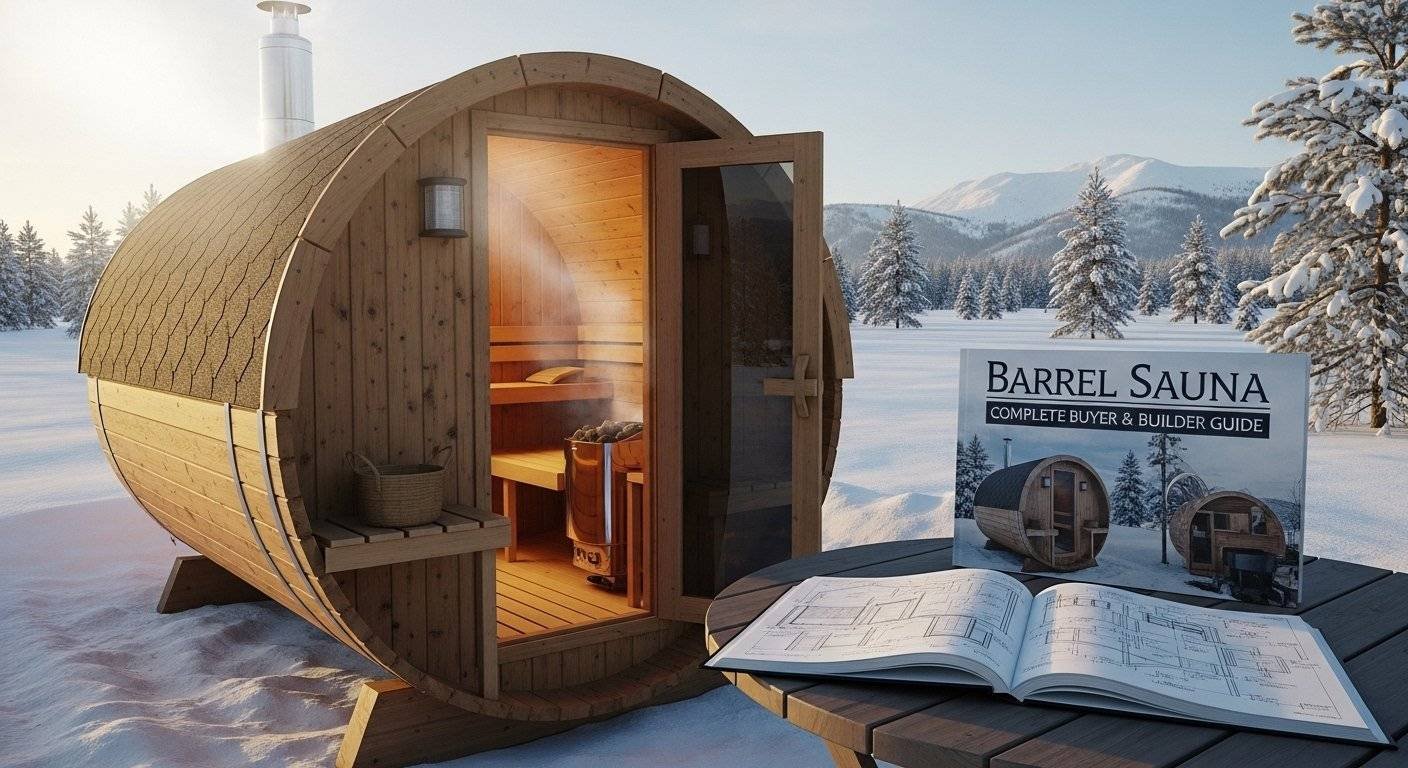
The barrel sauna has taken the backyard wellness world by storm, and it’s easy to see why. Its iconic curved shape, efficient heating, and striking visual appeal make it one of the most popular sauna styles among Canadian homeowners today. At Chinook Hot Tubs & Saunas, we’ve helped hundreds of customers choose, install, and enjoy barrel saunas perfectly suited to our climate.
Whether you’re considering buying a ready-made kit or building your own, this complete guide gives you everything you need, from how barrel saunas work to cost breakdowns, maintenance, and buying checklists.
A barrel sauna is a cylindrical sauna made from staves of wood banded together to form a rounded shape, similar to a wooden wine barrel. The curved interior eliminates corners, reducing the volume of air that needs to be heated while improving heat circulation throughout the space. Most barrel saunas sit on a cradle or platform outdoors, though some are designed for covered or semi-indoor installation.
While traditional Finnish saunas have existed for thousands of years, the barrel sauna design became popularized in North America and Europe in the late 20th century. Its compact, self-contained design made it ideal for residential backyards. Today, barrel saunas are one of the top-selling sauna formats, appreciated for their combination of efficiency, aesthetics, and ease of assembly.
The cylindrical shape of a barrel sauna means hot air naturally rises along the curved walls and collects evenly at the top, where the upper bench sits. This creates a smoother, more consistent temperature gradient compared to traditional rectangular saunas, which can have cooler corners. The reduced air volume also means barrel saunas heat up significantly faster — often in 20–30 minutes.
Most barrel saunas use either an electric sauna heater or a wood-burning stove with a rock basket. Water is ladled over the heated rocks to produce steam, raising humidity and perceived heat. The curved ceiling helps direct condensation away from users and channels it down the walls efficiently.
Because barrel saunas have less interior volume than traditional rectangular designs, they reach temperature faster and use less energy per session. A typical barrel sauna reaches 80–90°C in 20–30 minutes compared to 45–60 minutes for a larger cabin-style sauna. This makes them ideal for spontaneous use without long pre-heating waits.
The rounded roof of a barrel sauna naturally sheds snow and rain, making it exceptionally well-suited for Canadian winters. There’s no flat roof surface to accumulate heavy snow loads or pooling water. Cedar and other hardwoods used in barrel sauna construction are naturally moisture-resistant, extending the lifespan of the structure outdoors.
Traditional rectangular saunas offer more usable interior space per square foot of exterior footprint, and they’re better for large families or commercial settings. Barrel saunas are more compact and self-contained, making them ideal for smaller yards or patrons who prioritize aesthetics and efficiency over maximum capacity.
Barrel saunas win on ease of assembly; most kits arrive with pre-cut, pre-fitted staves and can be assembled by two people in a single day without specialized skills. Traditional saunas require more construction knowledge, more tools, and longer build times. For most homeowners, a barrel sauna kit offers the best balance of quality and convenience.
The most common type is designed to sit in a backyard on a cradle or platform. They come in lengths ranging from 4 feet to 8+ feet and accommodate 2–6 people. Most standard barrel saunas include benches, a heater, rocks, and a door as part of the kit.
A popular upgrade, panoramic barrel saunas feature a full glass end panel that provides a view of your outdoor surroundings while you relax. This design is particularly stunning in settings with natural landscapes, gardens, or winter snowscapes. The glass end adds cost but dramatically enhances the experience.
Pod saunas feature an elongated, oval cross-section rather than a perfect circle. They offer slightly more headroom and interior volume while retaining the barrel design’s efficient heat distribution. These are growing in popularity for homeowners who want a bit more interior comfort.
Barrel saunas are typically available in 4-foot, 5-foot, 6-foot, and 7-foot diameter options, with lengths from 4 feet to 8+ feet. A 4-foot-diameter by 6-foot-long sauna is comfortable for two people. A 6-foot-diameter by 8-foot-long version can comfortably fit 4–6 people with full-length benches on both sides.
Consider your primary use case: daily solo or couples use calls for a 2–3 person model, while a sauna you plan to share with family or guests warrants a 4–6 person size. Larger barrel saunas take longer to heat and consume more energy, so matching size to actual use patterns is important for both cost and comfort.
Basic barrel sauna kits start around $2,500–$4,000 CAD for a 2-person model. Mid-range 4-person kits with quality cedar and a good electric heater typically run $4,500–$8,000. Premium models with panoramic windows, custom interiors, and high-end heaters can reach $12,000–$20,000 or more.
Foundation or cradle installation costs $300–$800, depending on whether you use a pre-made cradle, a gravel pad, or a poured concrete base. Electrical installation for an electric heater typically costs $500–$ 1,500, depending on the proximity of the panel. Accessories like lighting, thermometers, and sand timers add another $100–$500.
Western red cedar is the top choice for barrel saunas due to its natural oils that repel moisture, resist rot, and emit a beautiful, calming scent when heated. It’s lightweight, dimensionally stable, and a pleasure to work with. Most premium barrel sauna kits use western red cedar for the staves, benches, and interior trim.
Nordic spruce is a popular and more affordable alternative, offering good dimensional stability and a clean, light appearance. Thermowood (thermally modified wood) is a step up from standard spruce, offering improved moisture resistance and a darker, richer tone. Both are excellent choices for budget-conscious buyers who still want a quality product.
Buying a barrel sauna kit is the most popular approach for homeowners because it delivers professional-quality, pre-engineered components that work together seamlessly. All staves are precision-cut and fitted, hardware is included, and assembly instructions are detailed. You save significant time and reduce the risk of costly mistakes.
True DIY barrel sauna construction from raw materials is technically demanding; getting the stave angles, banding, and sealing right requires woodworking skill and precision. It can save 20–40% on material costs, but is only recommended for experienced woodworkers. Most homeowners find that a kit delivers better results for a similar or lower total cost when time is factored in.
Choose a level site with good drainage and reasonable access to your home’s electrical panel. Install a gravel pad, pre-made cradle, or concrete pad, depending on your preference and local ground conditions. The cradle keeps the barrel off the ground, promotes airflow underneath, and protects against moisture accumulation.
Follow the kit’s assembly guide: build the end panels first, then slide the staves around the frame and band them together. Install the interior benches, heater, and ventilation components. Seal all exterior wood with a quality outdoor wood finish, and have a licensed electrician complete the heater connection before your first use.
The best placement is close enough to your home for convenient access but far enough away to provide a sense of retreat. Near a deck, pool, or garden near a natural environment creates a natural spa environment. Ensure your site has a clear path for electrical wiring and check municipal setback requirements from property lines and structures.
Position your barrel sauna so it’s screened from neighbouring properties if possible — a pergola, fence, or mature landscaping works well. Ensure the site drains away from the sauna to prevent water pooling around the cradle. In snowy Canadian climates, a downhill or sloped site helps with snow management and natural runoff.
Electric heaters are the most convenient option for barrel saunas, with precise temperature control and minimal maintenance. A 4–6 kW heater suits most 2–4 person barrel saunas. Harvia, Helo, and Finnleo models are popular at Chinook Hot Tubs & Saunas for their reliability and compatibility with most barrel sauna configurations.
A wood-burning stove offers a more traditional, off-grid sauna experience with authentic crackling heat. The chimney exits through the end panel or roof of the barrel, requiring careful sealing to prevent leaks. Wood-burning setups cost slightly more upfront but eliminate ongoing electricity costs and create an unmatched sauna atmosphere.
Apply a quality UV-resistant outdoor wood oil or stain to the exterior every 1–2 years to protect against weathering. In Canadian climates, the exterior will grey naturally over time if left untreated, this is purely cosmetic, but many prefer to preserve the original wood tone. Clean the exterior with a soft brush and mild soap before re-applying the finish.
Never apply any finish, oil, or stain to interior sauna surfaces, it can emit harmful fumes when heated. Simply scrub interior benches and walls periodically with a mild sauna cleaner or diluted baking soda solution. Leave the door slightly open after each use to ventilate and dry the interior.
New barrel saunas may show small gaps between staves initially, this is normal as the wood acclimates to outdoor conditions. Filling the sauna with steam (heating it empty a few times) helps the wood swell and seal naturally. Persistent gaps can be addressed with sauna-grade silicone or weatherstrip, though this is rarely needed in quality kits.
Blackening or grey patches on interior wood typically indicate mildew from insufficient ventilation. Always ventilate the sauna after use by leaving the door ajar. Affected areas can be lightly sanded and cleaned with a diluted hydrogen peroxide solution to restore appearance without damaging the wood.
For most homeowners, a barrel sauna delivers excellent value. The health and lifestyle benefits, stress relief, improved sleep, and muscle recovery are well-documented and ongoing. A high-quality barrel sauna also adds real market value to your property, as many Canadian buyers actively seek outdoor wellness features.
At Chinook Hot Tubs & Saunas, we consistently recommend barrel saunas to customers seeking the best combination of efficiency, ease of installation, aesthetics, and performance in Canadian weather. They’re genuinely one of the best outdoor investments for your home and among the most enjoyable. Visit chinookhottubsandsaunas.ca to explore our current barrel sauna selection.
Confirm the wood species and grade used in the kit. Verify the heater wattage matches your intended sauna size. Check that all necessary hardware, bands, benches, and a door are included. Review warranty terms for both the structure and the heater. Confirm delivery logistics; barrel sauna kits are heavy and may require a receiving team.
Inspect all staves and components for shipping damage before assembly. Verify all hardware quantities match the packing list. Read the full assembly guide before starting; the sequence of steps matters. Have your electrical installation booked in advance so there’s no delay between the completion of assembly and your first session.
A quality cedar barrel sauna, properly maintained with regular exterior oiling and post-use ventilation, can last 15–25 years or more. The wood structure is naturally durable, and most wear occurs on exterior surfaces that can be refinished. The heater typically lasts 10–15 years with proper care.
Yes, Barrel saunas are designed for outdoor year-round use and handle Canadian winters exceptionally well. The rounded roof sheds snow efficiently, and cedar’s natural oils resist freeze-thaw damage. Many owners enjoy their barrel sauna most in winter, stepping outside into fresh cold air between sessions.
An electric barrel sauna costs approximately $0.50–$1.50 CAD per hour to operate, depending on your local electricity rate and heater size. A 3-hour session once or twice a week adds roughly $10–$20 per month to your utility bill, a modest cost for the wellness benefits delivered.