


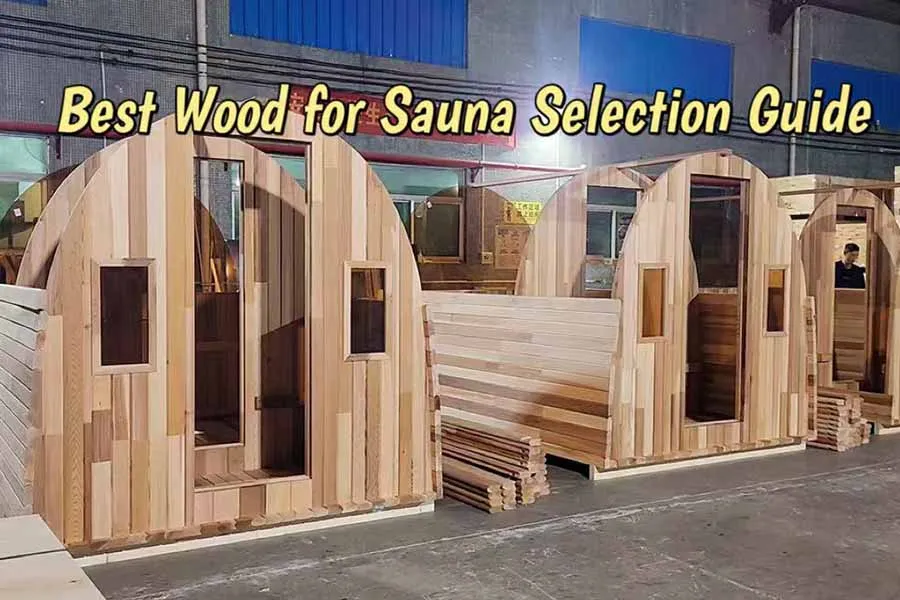
There is something deeply satisfying about a wood sauna. The moment you step inside, before the heat even reaches you fully, the walls and benches tell a story about craftsmanship and natural materials doing exactly what they were made to do.
Wood saunas have been the standard for thousands of years, and for genuinely good reasons. Wood insulates beautifully, breathes well in high humidity, feels warm to the touch, and creates an atmosphere that no synthetic material can replicate.
Prefabricated and acrylic saunas certainly have their convenience, but wood remains the benchmark when it comes to performance, aesthetics, and long-term satisfaction. The only question is which wood to choose, and that decision matters more than most people realize.
Not every wood can handle the conditions inside a sauna. Extreme heat, regular humidity swings, and constant thermal cycling mean only a select group of species perform reliably over the long term.
The best woods for saunas construction are:
Cedar performs exceptionally well both indoors and outdoors. Its dimensional stability, meaning its resistance to warping and cracking through repeated heat and moisture cycles, is outstanding. For a backyard sauna exposed to Canadian winters, cedar is genuinely one of the most reliable choices available.
Spruce is very light in weight and heats rapidly, which helps a sauna reach temperature efficiently. It does have a natural resin content that can occasionally weep in intense heat, so choosing kiln-dried and knot-free material is important. Properly selected spruce performs beautifully and lasts for decades.
Hemlock is gaining popularity as an excellent cedar alternative, particularly for people who prefer a more understated aesthetic. It has a fine, consistent grain, a soft tone ranging from pale cream to light brown, and very little natural scent, which makes it neutral and pleasant for all-day use.
Aspen is the right choice when sensory sensitivity is a priority. It contains virtually no resin and produces no noticeable scent, making it perfect for people with respiratory sensitivities or those who prefer a completely neutral aromatic environment.
Basswood shares many qualities with aspen. It is soft, light, resin-free, and hypoallergenic. Its consistent grain and clean appearance make it a popular choice for infrared sauna kits and pre-built units.
Thermally modified wood is created by subjecting timber to extreme heat in a controlled, oxygen-free environment. This process dramatically improves moisture resistance, dimensional stability, and durability. The result is a wood that performs like a tropical hardwood but uses sustainably sourced domestic or European species.
Teak is the premium choice for outdoor sauna flooring and exterior elements. Its naturally high oil content makes it extraordinarily resistant to moisture and decay. It is hard, heavy, and long-lasting, though also more expensive than most alternatives.
Canadian climates push sauna materials hard. Temperature swings from minus thirty in winter to plus thirty in summer, combined with heavy snowfall, ice, and UV exposure, demand wood that is both dimensionally stable and naturally protective.
For outdoor saunas in Canada, Western Red Cedar and thermally modified wood consistently outperform other options. Cedar’s natural oils shield it from both moisture absorption and UV degradation. Thermally modified wood, meanwhile, has had almost all of its moisture-absorbing properties eliminated through the treatment process, making it virtually impervious to the effects of freeze-thaw cycling.
For indoor or semi-sheltered Canadian saunas, hemlock and Nordic spruce are both excellent performers. They are warm, stable, and widely available through Canadian lumber suppliers, which also keeps project costs reasonable.
Knot-free wood matters both for safety and for long-term performance.
Knots are denser than the surrounding wood and conduct heat differently. In a sauna bench or wall where surface temperatures are elevated, a knot can become uncomfortably hot to the touch and even develop small cracks over time as it expands and contracts at a different rate than the surrounding grain.
Knot-free lumber also looks significantly cleaner and more refined inside a sauna. The even grain creates a smooth surface that is easier to clean, less prone to splinters, and much more pleasant under bare skin during a session.
Choosing the right wood for your sauna is one of those decisions that you quietly appreciate for years afterward. The right species stays strong through every Canadian winter, holds its beauty season after season, and creates an interior environment that genuinely invites you back.
Cedar for warmth and tradition. Hemlock for simplicity and value. Thermally modified wood for outdoor resilience. Each has a place, and all of them can build something remarkable.
The Chinook team loves helping people find the right sauna for their space, their climate, and their lifestyle.